If you have a health concern, you should talk to your doctor about Lumigan before using it. You should discuss Lumigan with all of your health care providers, including your dentist, pharmacist, and doctor. Follow your doctor’s instructions for use and read all of the information carefully. Read all of the ingredients in Lumigan and any precautions before starting it. The drug may cause side effects, including serious stomach upset. This medication should be taken exactly as prescribed.
Bimatoprost
When using Lumigan, you should be aware of potential adverse effects and to seek medical attention if you experience any of these conditions. Lumigan may interact with other drugs, including Bimatoprost, latanoprost, and travoprost, so it’s important to discuss possible interactions with your healthcare provider. Some of the possible Lumigan side effects include itching, swelling of the face, skin rashes, and temporary, unstable vision. If Lumigan affects your vision, you shouldn’t engage in activities that require clear vision.
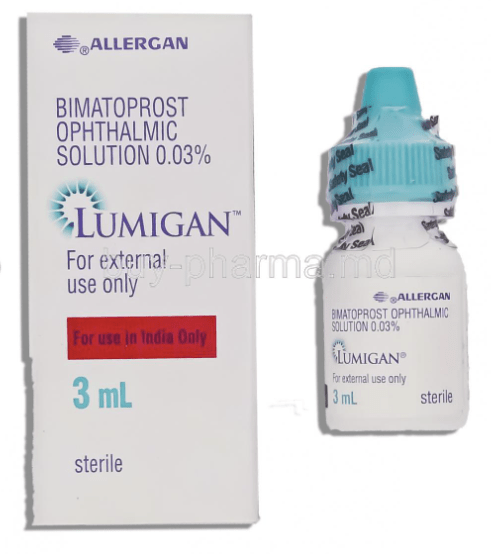
Buy Lumigan
One common side effect of bimatoprost is eye irritation, which can lead to watering or redness. To prevent this from occurring, simply rinse your eye thoroughly after using the medication. You shouldn’t put the medication back in your eye until your next dose, so any irritation or redness should subside on its own in a few hours. If you accidentally swallow a small amount of the medication, you should contact your healthcare provider immediately.
In addition to lowering eye pressure, bimatoprost is also used to treat ocular hypertension and open-angle glaucoma. Because high eye pressure can lead to blindness, bimatoprost works to regulate the flow of fluid in the eye. To prevent eye pressure from becoming too high, patients should take bimatoprost at least once daily for best results.
Although bimatoprost does not affect fertility, it does reduce the development of the ocular tissues. Moreover, bimatoprost does not appear to affect fetal or embryonic development in mice. However, when administered to rats, bimatoprost reduced gestation time and increased foetal death. During rat perinatal studies, bimatoprost significantly decreased pup body weights.
In vitro studies showed that bimatoprost penetrates the cornea and sclera and does not accumulate in the blood. In humans, blood concentrations peaked at about 10 minutes after instillation and decreased to the lower limit of detection within 1.5 hours. The mean Cmax and AUC (0-24hr) on days seven and 14 were similar. Bimatoprost’s AUC (area under the curve) remained stable after ocular dosing for about seven days.
While bimatoprost is a highly effective topical treatment for blepharitis, it is important to note that if you already have a condition that might affect its effectiveness, it may be inadvisable to use LUMIGAN for that condition. As with any topical ophthalmic medication, the drug should be administered at least five minutes apart from one another. Bimatoprost can be absorbed through contact lenses.
There have been a number of adverse reactions associated with LUMIGAN. The most common one is the gradual change of eyelashes. This effect is temporary and reversible when LUMIGAN is stopped. There are also reports of intraocular inflammation. However, these reports are rare. In addition, these drugs should be used cautiously in patients with known risk factors for macular edema.
While bimatoprost PF and lumigan are non-inferior in the majority of cases, bimatoprost PF was found to be statistically equivalent to bimatoprost in the ITT population. The 95% CI margins for the treatment differences between the two groups were within a mm Hg range. This result supports the use of both drugs.
Patients should wait at least 5 minutes between the two medications before applying them to their eyes. Unlike other eye ointments, eye drops should be used before ointments. This will allow the medicine to enter the eye. Patients should use bimatoprost and lumigan as prescribed by their healthcare providers. Even if they feel well, they should still use the medications because glaucoma does not typically have any symptoms.
Increased pigmentation of the iris has been reported with the use of bimatoprost ophthalmic solution. It is not clear whether this pigmentation is permanent or reversible. During this time, the brown pigmentation in the pupil is spreading to the entire iris. These changes may not be noticeable at first, but may occur several months or even years after the drug is stopped.
Despite these concerns, bimatoprost and lumigan are effective eye medications for lowering intraocular pressure. However, there are several things you need to be aware of before using these eye drops. First of all, it’s important to discuss the possible side effects with your doctor. Bimatoprost is not suitable for people with heart block that’s more than first degree. It may also result in reduced blood pressure.
Benzalkonium chloride
Benzalkonium chloride is a common ingredient in many prescription eye drops. Lumigan is a brand name for a bimatoprost formulation that is less than 0.03%. Although many patents disclose that benzalkonium chloride is used in bimatoprost eye drops, the scientific literature rarely reports any other formulations. This lack of effective alternatives calls for inventive ingenuity on the part of researchers.
Patients using Lumigan should be aware that this eye drop may cause bacterial keratitis, a serious infection caused by contamination of the eyedrop bottle. To avoid this, make sure you wash your hands thoroughly before using Lumigan. Afterward, do not touch the tip of the dropper with your eye. Because benzalkonium chloride can damage soft contact lenses, it is best to remove them before using Lumigan. After instilling the solution, wait at least 15 minutes before putting back your contacts.
As an alternative to benzalkonium chloride, the invention provides a method and formulation for reducing intraocular pressure. The formulations of the invention eliminate potentially toxic benzalkonium chloride and incorporate non-toxic substances, such as polysorbate 80, in an amount comparable to LUMIGAN(r) 0.01%. These formulations reduce intraocular pressure to an acceptable level, compared to the previous LUMIGAN(r) 0.01%.
The effects of benzalkonium chloride on ophthalmic drugs have been studied in a number of studies. The effects of the drug on human corneal epithelial cells were shown to be cytotoxic to several corneoconjunctival cell lines. These antiglaucoma drugs were also cytotoxic to multiple human corneal epithelial cells. They are not safe for prolonged use in patients with eye conditions or corneal abnormalities.
Lumigan (r) 0.03% bimatoprost ophthalmic solution was approved by the FDA in 2001. Its 0.01% formulation contains bimatoprost, sodium chloride, citric acid, and purified water. The manufacturer recommends administering one drop in the affected eye(s) once a day. Frequent administration may decrease the effect of the drug on intraocular pressure.
For regulatory purposes, the difference in mean IOP from baseline was determined. Bim 0.01% and LUMIGAN(r) 0.125% were both favoured. The latter were also found to be more effective than Bim 0.01% and 0.05125%. In both cases, the upper limit of 95% CI for the between-treatment difference was within a 1.50 mm Hg margin.
Although the adverse reactions associated with LUMIGAN were low, some patients experienced milder reactions. The most common one was conjunctival hyperemia. Other adverse reactions included ocular edema, eye pain, increased lacrimation, skin hyperpigmentation, and periorbital changes. Despite these minimal risks, patients with COPD should exercise caution and discontinue LUMIGAN immediately if these symptoms develop.
LUMIGAN 0.01% should be used only by trained physicians. Do not use this product on contaminated surfaces. In some cases, it may cause serious eye damage and loss of vision. For patients with any ocular condition, consult your physician before using LUMIGAN (r) 0.01%. The solution should not be used for more than 5 minutes at a time. In addition, LUMIGAN (r) 0.01% should not be used on contaminated surfaces.
 United Academy Art Blog